- Time spent in the studio is not ever wasted. “Bad” days are a requirement for good days.
- You know the old adage, 10 pennies make a dime, 10 dimes make a dollar…never discount small change and never discount small segments of time. Use 15 minutes when they are available, don’t waste them because you need an hour to get warmed up. Extended time is best, of course, but find a way to work in little bits of time, sometimes that’s all you get.
- Don’t wait for an idea to go to your studio or work area. Go whether you have something cooking or not. Draw what is in front of you, move paint around…. Fooling around is not time wasted, it is play and it is important.
- Do not allow interruptions. Do not answer the phone or check email during studio time; it is too easy to get sucked away from the work. Stay focused during even (ESPECIALLY) if things are not going well.
- When possible, quit when things are going very well, you’ll want to return as soon as possible.
- Incorporate something related to your practice into everyday; spend 20 minutes with your visual journal, google an artist or museum.
- Create a schedule and stick to it. You make a choice and if you want your work to evolve you must commit to spending as many hours as possible doing it.
Studio Time Tips


Featured Artist: James Castle
About James Castle:
1899-1977, lived and worked in Idaho.
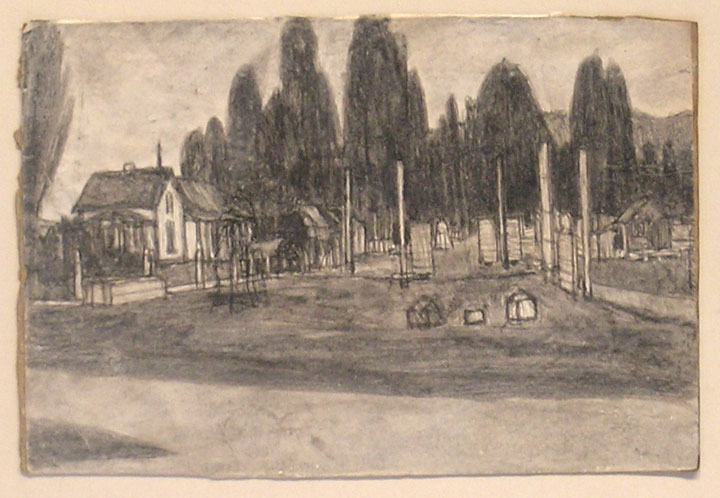
Born in 1899 in rural Garden Valley, Idaho—only nine years after that frontier territory was admitted to the Union—James Castle mined the local landscape of his family’s homesteads and mapped his deeply private domestic world to produce a remarkable body of drawings, collages, and constructions. The singularity of Castle’s communicative impulse and prolific creative practice can be traced to his experiential focus. Profoundly deaf since birth, he never learned how to sign, read, or write in a conventional manner, but instead communicated through the eloquent vehicle of his art. Over the course of a life lived on his family’s three successive farms, he amassed thousands of works on and in paper—his parents’ role as postmasters likely providing much of this ephemera—appropriating fugitive scraps of printed matter and packaging materials for use as surfaces, collage elements, and source material to draw from memory. The bulk of Castle’s work can be classified as drawings, rendered in his preferred medium (chosen over orthodox materials) of stove-soot in saliva—and sometimes a mysterious “color of an unknown origin,” probably pigment extracted from paper-pulp—applied with a sharpened stick as stylus. Known initially for his expressionistic representational landscapes and interior—sensitively drawn, usually monochromatically, from observed rural life and fantasy—Castle has come to be recognized in recent years for the full breadth of his work, which encompasses an important (though perhaps less accessible) body of abstract drawings, color meditations, loosely representational constructions, collages, and text drawings. Working exclusively with humble available materials and always in an intimate scale, Castle epitomizes the bricoleur’s method, particularly in his complex reconfigurations, dissections, and inventions of typeface in his text appropriation drawings and collages. He garnered some local acclaim during his lifetime (including 1963 and 1976 exhibitions at the Boise Gallery of Art) but only achieved international recognition decades after his death in 1977. James Castle's work is now included in major museum collections throughout the U.S., including the American Folk Art Museum, the Museum of Modern Art, and the Whitney Museum of American Art in New York; the Philadelphia Museum of Art; the High Museum in Atlanta, Georgia; the Boise Art Museum; and the Art Institute of Chicago. —Brendan Greaves Above: Portrait of James Castle, 1974, (c) H. Clare Wiser.
Bibliography
Anderson, Brooke Davis, “James Castle,” Raw Vision, 46 (Spring 2004): 53.
Subscribe to:
Posts (Atom)
